Which Products
Do We Produce?

The Right Box for Every Accessory

Technical Specifications

For brands aiming to elegantly present ties, cufflinks, and similar men’s accessories, we designed boxes in various shapes. With a range of models such as hinged cardboard boxes with lids and drawers, and hinged plastic boxes, we offered solutions that both reflect the brand’s style and securely display the products. These boxes, catering to different market segments, transform the gift and sales experience into a cohesive presentation.

Home Textiles Presentation with Elegant Details

Technical Specifications

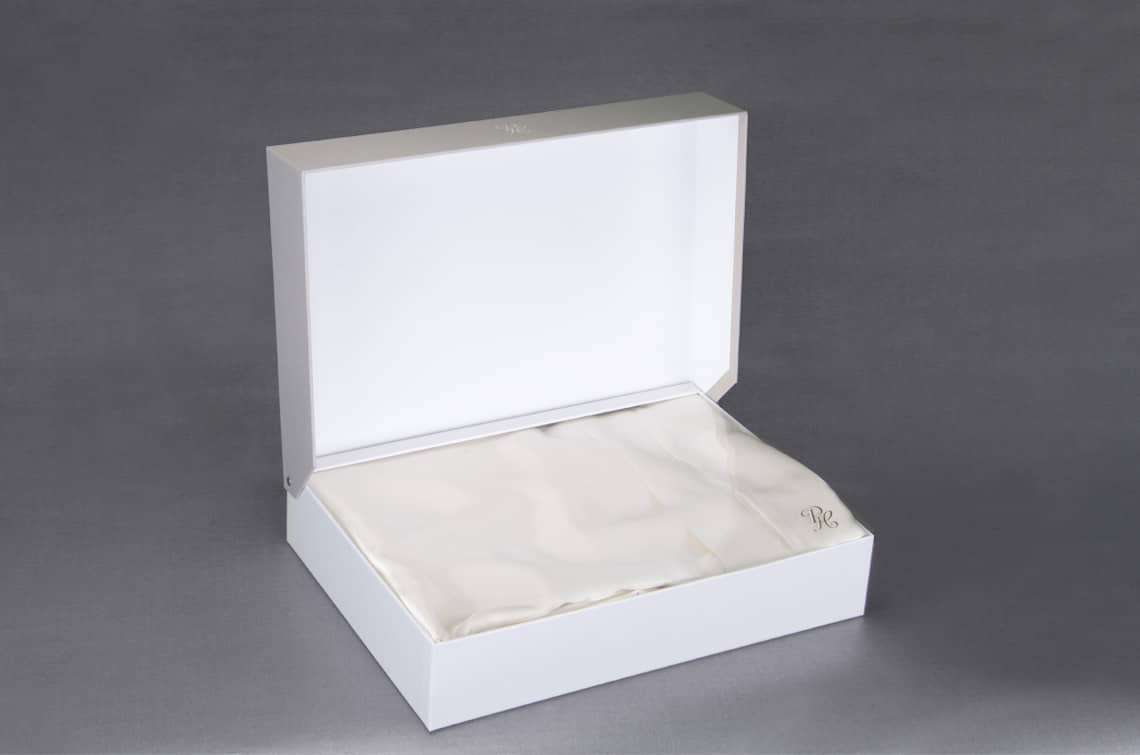
For this bedding box designed for a home textiles brand, we focused on details that would both enhance the product’s aesthetic value and provide ease of use. Due to the large size of the box, metal hinge accessories were used to ensure the lid opens and closes smoothly and evenly. To protect the product and enrich the presentation, a transparent protective layer with a logo print applied on acetate paper was added.

Textile Boxes Standing Out with Functional Elegance

Technical Specifications

For an international menswear brand, we produced cardboard boxes in different sizes and functions to suit their wide product range. The transparent window applied to the shirt boxes allowed the contents to be easily viewed before purchase, while repeatable quality and durability were ensured in high-volume production. The embossed hot foil stamping used on all boxes stood out as a production detail that reinforced the brand’s premium identity. With this systematic production structure, adaptable to different sizes, both aesthetic and operational efficiency were achieved.

Luxury Textile and Accessory Boxes

High-End Packaging Manufacturing

Aesthetic perception begins with the detail. Every brand that epitomizes luxury understands that product presentation must be a holistic integration of not only visual appeal but also material selection, the finesse of craftsmanship, and the user experience. At Gıpta Packaging, we manufacture with this exact philosophy.

Textile and accessory boxes serve as more than mere vessels for transport and protection; they are the vanguards of your collection, rendering your brand’s style codes visible. Each box is meticulously shaped through technical precision, high-grade paperboard, and advanced surface finishing techniques.

Whether it be an exquisite scarf collection, bespoke apparel packaging, or wholesale accessory solutions—every box is manufactured as an amalgamation of design passion, rigorous engineering, and cutting-edge printing technology.

On this page, you will find comprehensive details regarding luxury textile packaging, apparel box manufacturing, and corporate accessory solutions, with a particular focus on wrapped rigid paperboard textile boxes.

Why Choose Bespoke Textile Boxes for Your Brand?

Packaging is not merely an outer layer; it is the primary stage that reflects the product’s character, the brand’s promise, and its aesthetic vision to the outside world. Especially in the textile and accessory sectors, ordinary solutions are insufficient to differentiate oneself on competitive shelves and digital storefronts. Custom-manufactured textile boxes become a strategic necessity at this juncture, rather than just an aesthetic choice.

The First Impression Commences with Luxury

The user establishes their initial contact with a garment or accessory through the box. For this encounter to transform from a mere “purchase” into an “experience,” the packaging must possess both functional and emotional layers. A custom-manufactured textile box:

  • Directly reflects the brand’s visual language.

  • Enhances the perceived quality of the product.

  • Instills a sense of “acquiring something special” in the customer.

  • Supports social media shareability.

Today, even a simple scarf box, when designed correctly, can evoke a luxury segment perception. This effect is magnified exponentially when combined with durable and prestigious materials, such as wrapped rigid paperboard textile boxes.

Renders Brand Identity Visible

Design is not merely aesthetic; it is a strategic decision-making mechanism. Through custom-manufactured boxes:

  • Your color palette is translated onto the box.

  • Your logo elevates the brand’s value through details like embossing or foil stamping.

  • Your brand narrative is sustained through slogans, QR codes, or internal printing.

This holistic approach reinforces the perception that your brand offers its values, not just a product. Especially for boutique brands or those positioned in the luxury segment, this packaging holds as much representative power as a business card.

Influences Consumer Behavior

Most users attribute greater value to a product influenced by its packaging. This psychological effect directly impacts price perception and the purchasing decision. Consider the following example scenario:

  • Does the same shirt appear more impactful in an ordinary kraft bag, or in a branded box featuring a magnetic closure, a soft-touch finish, and a logo?

The second example is not only more elegant but also conveys a sense of “preciousness.” This represents an invisible investment that enhances customer satisfaction, particularly in the gift segment and online sales.

The Unboxing Experience and Brand Loyalty

Packaging is no longer merely for transit; it is an integral part of the “experience” presented alongside the content. This is precisely the focal point of the unboxing videos seen on YouTube or Instagram: the sensation provided by the box. Through custom-manufactured boxes:

  • The user is impressed upon the initial contact with the product.

  • They wish to keep the packaging (potential for secondary use).

  • They forge an emotional connection with the brand.

Consequently, this increases both loyalty and social media engagement.

Luxury Textile Packaging: Silent Ambassadors Shaping Perception

Luxury is not a concept; it is an experience. This experience begins with the texture, the form, and the tactile sensation of opening the package. The luxury textile packaging manufactured by Gıpta Packaging serves as more than just an outer protector; it acts as a silent yet potent ambassador carrying your brand’s value proposition.

The Psychology of Packaging: Perceived Value and Expectation

When a customer reaches for a product, they are touching an expectation rather than just a physical object. That expectation is embedded within the appearance, weight, closure mechanism, and surface texture of the packaging.

For instance:

  • A logo rendered in hot foil stamping alludes to quality.

  • Matte lamination offers a sophisticated poise.

  • Embossed surfaces create a tactile sense of luxury.

All these details convey the message “this brand offers quality” even before the product is seen. This is precisely why luxury packaging precedes the product; because it commands perception.

Silent Yet Potent: The Communicative Role of Packaging

Packaging does not speak, yet it articulates a great deal. Every line, color, and texture used in its design is a fragment of your brand narrative. The luxury textile boxes offered by Gıpta reflect:

  • Modernity through minimalist lines,

  • Prestige with gold accents,

  • Sustainability through natural textures.

This visual and tactile language presents a wordless narrative to the user—one that distinguishes itself from the “standard” solutions offered by competitors.

Post-Use Value: Encouraging Retention

A luxury textile box is not destined for the bin once its initial task is complete. Typically, it:

  • Becomes a keepsake storage box,

  • Serves as an organizational item for closets,

  • Is repurposed for gifting,

  • Is remembered, reused, and shared.

This translates to your brand permeating homes, lives, and memories. The packaging is not merely “temporary”; it is the key to long-term brand engagement.

Segmentation: The Shades of Luxury

At Gıpta, we do not present luxury in a singular form. Every brand, every collection, and even every season possesses a distinct voice. Therefore, we provide suitable alternatives such as:

  • Premium cardboard boxes for minimalist and contemporary collections,

  • Magnetic rigid boxes for dignified and traditional collections,

  • Satin-lined boxes for elegance-focused accessories,

  • Velvet-textured surfaces for gifts or special edition products.

Every design is positioned strategically rather than just aesthetically. This is why Gıpta packaging does not merely create an perception of luxury; it manages it.

Wrapped Rigid Paperboard Textile Boxes: Form, Durability, and Elegance

Packaging should not merely serve a transport function; it must be as robust, elegant, and consistent as the product it contains. Particularly in the textile sector, the quality of presentation is as prominent as the delicate nature of the products. At this juncture, wrapped rigid paperboard textile boxes offer brands more than just packaging; they provide a value-enhancing structure.

What is Wrapped Rigid Paperboard? Why is it Preferred?

Wrapped rigid paperboard is a multi-layered packaging material obtained by adhering premium art paper or specially textured papers to the outer surface of thick paperboard (greyboard).

The advantages offered by this structure include:

  • High durability: Does not easily crush; maintains its form.

  • Superior presentation: The outer surface, onto which designs are applied, supports all types of printing and surface treatments.

  • Luxury perception: Its weight and rigidity render the product “precious.”

In segments such as apparel, footwear, bags, and scarves, it represents one of the most ideal solutions for both protection and presentation.

Form & Structural Design: The Identity of the Box

The success of a box lies not only in its durability but in the relationship it establishes with the product. At Gıpta, we pose the following questions during the design of every wrapped rigid paperboard box:

  • Is the opening orientation of the box most suitable for the product?

  • Is the internal insert solution sufficiently balanced and aesthetic?

  • Does the box evoke a sense of “surprise” at the moment of initial contact?

The boxes resulting from our answers to these questions are more than mere carriers; they add a transformative effect to your brand’s stage performance.

Aesthetic Details: The Art of Surface and Texture

Wrapped boxes provide one of the most suitable substrates for surface treatments. Specifically:

  • Hot Foil: Elegant accents with gold, silver, or holographic details.

  • Emboss/Deboss: A three-dimensional appearance for the logo, providing tactile richness.

  • Soft Touch Lamination: A velvety sensation, creating a modern and elegant atmosphere.

  • Spot UV: A contrast effect through selective gloss on a matte surface.

Through these techniques, boxes become an aesthetic element as significant as the product itself.

We Do Not Compromise on Functionality

Luxury packaging should not consist solely of outward appearance. User-friendly details are also the foundation of every design:

  • Magnetic closure systems

  • Drawer-style or lid-and-base models

  • Internal separators or velvet-lined compartments

  • QR codes, holographic security labels

All these features enhance functionality from both a logistical and user-experience perspective.

Sectoral Harmony and Adaptation

The wrapped rigid paperboard textile boxes offered by Gıpta can be easily adapted to various fields beyond the fashion industry, such as corporate gift items, e-commerce packaging, and collection promotional kits.

Whatever your product structure may be, designing a box that ensures the balance of form and function is within our expertise.

Our Quality Standards as a Clothing Box Manufacturer

In the textile industry, regardless of how meticulously a product is prepared, integrity cannot be achieved unless the packaging carrying it demonstrates the same level of care. When a first-class shirt or a bespoke jacket is presented in an ordinary box, the perception of value diminishes. As a clothing box manufacturer, we do not merely establish this cohesion; we redefine it at the intersection of aesthetics and engineering.

Control and Consistency at Every Stage of Production

At Gipta, our production process transcends mere printing and cutting. In every project, we advance based on three core criteria:

  • Consistency: The same quality level from the first prototype to the final product.

  • Accuracy: Exact alignment with your brand’s dimensions, corporate colors, and textural requirements.

  • Timing: Commitment to delivery dates and seamless logistics.

These standards provide confidence not only to the client but also to the end consumer.

Technical Details That Define Quality

The elements that determine the quality of a clothing box are multi-layered:

  • Material thickness: Offering durability tailored to the product with paperboard options ranging from 1.5 mm to 3 mm.

  • Locking mechanisms: Providing a rich experience through various opening styles such as magnets, string-ties, or drawer-style structures.

  • Internal organization: Support systems (cardboard, fabric, or foam lining) that ensure the garment remains securely positioned without shifting inside the box.

  • Protection against moisture and heat: Surface coatings and packaging configurations resistant to climatic conditions, especially for export projects.

These technical details extend the shelf life of the box while ensuring superior performance during the transport and presentation process.

Invisible but Felt Elements

Quality is sometimes intangible, yet it is always noticed. The details that create that distinction include:

  • The slight sense of resistance when the lid is opened

  • An eye-catching matte finish that is non-reflective

  • A smooth texture that is non-slip to the touch

  • Perfectly aligned closure of the lid

  • The absence of deformation while the box is being carried

These details define the line between “ordinary packaging” and “luxury brand presentation” in the eyes of your customer.

Sector-Based Adaptations

Every garment carries its own narrative. To produce boxes suitable for that narrative, we offer solutions adapted to the demands of different sectors:

  • For retail stores: shelf-ready boxes, models with carrying handles

  • For e-commerce projects: impact-resistant, foldable structures

  • For gift collections: boxes featuring decorative ribbons and silk linings

  • For high-fashion brands: luxury boxes with custom patterns and numbering

Whether you are a boutique brand or a global chain, we provide high-precision packaging shaped by your needs with our production capacity.

Scalable and Flexible Production with Wholesale Textile Boxes

Whether your packaging needs are limited to a single campaign period or concern a collection spanning the entire season, the scale and flexibility of the solution become critical as requirements grow. This is precisely where the solution comes into play: wholesale textile boxes. At Gipta Packaging, we don’t just produce boxes — we offer high-volume, multi-series, time-sensitive packaging solutions.

Why Wholesale Production? What are the Advantages?

Wholesale production does not only create a cost advantage. It also:

  • Provides a standardized presentation that increases brand visibility.

  • Offers a consistent box experience for every branch, store, or point of sale.

  • Creates ease in inventory planning and logistics processes.

  • Enables high-volume distribution for seasonal or promotional products.

These advantages create critical differences, especially for chain stores, e-commerce brands, textile exporters, and corporate gift projects.

Production Capacity and Volume Management

Thanks to Gipta’s high-volume production infrastructure:

  • Daily production capacity of 10,000+ boxes

  • Simultaneous production in multiple models and sizes

  • Concurrent printing and assembly for 5–10 different collections with series production

  • Priority shipment planning and regional distribution advantages during the production process

This provides a significant advantage in terms of delivering projects of every scale on time and maintaining quality standards.

Is Customization Possible in Wholesale Orders? Yes!

One of the questions we frequently hear is: “Is customization possible in wholesale orders?”
Our response: Of course. Because every brand’s audience, collection, and narrative are different.

In wholesale production as well:

  • Your logo, colors, and slogans can be used.

  • Packaging in different sizes can be produced in a single run for the same collection.

  • Special touches can be added to each series through surface treatments (e.g., gold foil only on campaign boxes).

  • Logistics support prints such as serial numbers, QR codes, barcodes, and collection labels can also be integrated.

In short, it is not handled as “wholesale production = uniform boxes,” but rather as “scaled yet differentiated solutions.”

Cost Optimization and Logistics Efficiency

One of the most concrete contributions offered by wholesale production is the cost advantage. Thanks to high-volume production:

  • Unit costs decrease,

  • Material waste is minimized,

  • Time loss is avoided,

  • Logistics planning becomes more efficient and consistent.

Additionally, logistics support solutions such as bulk shipment after production and direct delivery to domestic and international centers are organized specifically for the project.

Custom Solutions We Offer as an Accessory Box Manufacturer

Accessories are small but impactful details; just like the packaging that carries them. A watch, a bracelet, or an elegant tie is not merely a product; it is a whole with the story it represents, its symbolic value, and its prestige. That is why the solutions we offer as an accessory box manufacturer aim not only for protection but for carrying meaning.

The Code of Accessory Packaging: Scale, Material, Elegance

Accessories are generally small-sized but high-meaning products. Boxes used for these products must:

  • Carry the product without shaking,

  • Include aesthetic details,

  • Reflect the identity of the collection,

  • Be practical in terms of logistics.

Therefore, at Gipta, for accessory boxes we offer:

  • Wrapped rigid paperboard,

  • Foldable cardboard boxes,

  • Magnetic closure boxes,

  • Drawer-style boxes with internal supports,

  • Satin fabric-lined or multi-compartment designs.

Each is shaped according to the size, value, and presentation style of the accessory.

Small Product, Large Perception: Value Growing through Packaging

Minimal products such as a pin, brooch, or cufflink are usually purchased and presented for gift purposes. In such products, the box:

  • Doubles the luxury perception of the product,

  • Makes the gifting experience special,

  • Enriches the social media and unboxing experience.

The accessory box is not just a transport tool here, but a platform for emotional transmission.

Custom Design for Collections

Many brands release products with different themes every season. Accessory collections also change in parallel with these themes. We develop solutions suitable for the spirit of each collection:

  • Boxes with color variations,

  • Special prints for limited editions,

  • Sustainable packaging alternatives,

  • Retro, modern, minimal, or baroque style applications.

Thanks to this flexibility, brands can speak a different packaging language in every series.

Corporate Gift and VIP Solutions

We manufacture not only for retail but also for corporate accessory projects. For example:

  • Branded tie boxes

  • Planner + pen + keychain set boxes

  • Satin-lined boxes for leather accessories

  • Custom-fit internal layout solutions for metal pins

These types of boxes play a prestige-enhancing role in many areas, from internal company promotions to VIP event gifts.

Production Flexibility from Small Batches to Wholesale Orders

We offer solutions for needs of every scale, from entrepreneur brands to chain stores. Especially for a newly launched accessory brand:

  • Low-volume, customized production can be done.

  • As production grows, cost advantages are provided in the transition to mass production.

  • Different size variants of the same box model are easily created.

In short, both boutique detail and industrial scale meet under the same roof.

Wholesale Accessory Boxes: Optimized Packaging for Your Collections

Accessories are essential pieces that reflect the details of collections, style codes, and seasonal themes. However, the boxes that carry these pieces require the same level of care, and even engineering. Especially in collection-based sales, stocked operations, or shipments made for chain stores, wholesale accessory boxes make a significant difference.

A Collection-Based Design Logic, Not a Uniform One

Wholesale box production is equated with “standardization” by many. However, at Gipta, we preserve variations in style and content in boxes, just as in the different products of a collection.

For example:

  • Boxes in 3 different sizes for 3 different bracelets with the same design line

  • The same logo but in 2 different color variants (e.g., black and damson)

  • Special effect applications on the printing surface according to the theme of the season

  • Packaging that differentiates with different surface treatments for VIP customers

In this way, your brands can ensure conceptual integrity through packaging in their collections.

Series Production Capability and Quality Consistency

Gipta’s high-volume production power makes it possible not only to print “a large number of boxes” but also to maintain the same quality in each of these boxes.

  • Every box comes out in an equal form with cutting precision at the micron level.

  • Thanks to print color consistency, no visual difference occurs in stores or online showcases.

  • Surface treatments maintain the same smoothness and textural quality in all boxes.

This consistency reinforces your brand’s perception of professionalism.

Logistics and Storage Advantages

In wholesale accessory boxes, not only production but also the subsequent processes must be considered. At Gipta, in this field, we offer:

  • Palletized packaging shipment,

  • Labeling with serial numbers,

  • Mixed boxing according to the warehouse,

  • Logistics solutions such as split deliveries instead of bulk.

This makes the process from production to the store more seamless and systematic.

Ideal for Campaign and Seasonal Production Periods

Especially for special days, season openings, or campaign periods, a wholesale production strategy provides advantages in terms of cost and planning.

  • Special prints for periods such as Valentine’s Day, New Year’s, Mother’s Day

  • Special numbering and certification boxes for limited edition collections

  • Pre-planned production schedule with fast delivery guarantee

Thanks to all these elements, brands can move away from planning stress and focus on their products.

Paperboard Textile Boxes: Material Character and Application Areas

Packaging is a matter of form, but the material behind that form is the backbone that determines a brand’s quality and durability. When it comes to textile products, one of the most robust candidates for this backbone is: Paperboard.

Particularly preferred by luxury and upper-mid segment brands, paperboard textile boxes stand out not only for their structural strength but also for their aesthetic potential and printing surface.

What is Paperboard? Why is it Preferred in the Textile Sector?

Paperboard is a dense, rigid packaging material obtained by compressing layers of paperboard joined in different strata. Specifically, its advantages include:

  • Rigidity: It preserves the box form for a long time.

  • Malleability: It allows for precise architectural designs.

  • Print compatibility: It can be customized with art paper, kraft, or specialty paper coatings.

  • Surface treatment support: It is suitable for luxury details such as embossing, foil stamping, and UV coating.

These features offer both elegance and protection for product groups such as luxury apparel, children’s textiles, lingerie, and shawl/scarf collections.

Forms Change, Material Remains: Design Flexibility

Paperboard is virtually a playground for designers. With a single material, one can produce:

  • Book-style boxes with magnetic closures,

  • Drawer-style and multi-compartment solutions,

  • Lid-and-base models or designs with handles,

  • Circular, hexagonal, or oval forms.

This flexibility supports both alignment with corporate identity and the uniqueness of seasonal collections.

Product Protection: Variable Climate, Stable Box

Products intended for export or online sales may encounter varying climatic conditions. Paperboard textile boxes stand against these conditions with:

  • High moisture resistance (which can be further enhanced with coating materials).

  • Minimal form distortion.

  • Capacity to carry heavy products (e.g., blazers, coats).

  • Long shelf life, allowing for storage without deformation.

In other words, the box continues to function not just before the sale, but during post-sale usage as well.

A Texture Integrated with Brand Identity

Paperboard is not just a technical material; it is an emotional material. It provides an impression of the brand the moment it is touched. For example:

  • Velvet-textured coating: Appeals to feminine and elegant brands.

  • Kraft print + embossed logo: The choice for minimalist and eco-conscious brands.

  • Glossy lamination + UV printing: Suitable for modern, urban, and striking brands.

At Gipta, we view every paperboard box not merely as a material, but as a brand signature, and we shape it accordingly.

Paperboard Accessory Boxes: Functional Aesthetics

Accessories may be small, but their impact is significant. Similarly, the packaging that carries them must be both minimalist and full of meaning. The solution that best achieves this balance is: paperboard accessory boxes. At Gipta Packaging, we treat these boxes not merely as a means of protection, but as a designed experience.

Merging Functionality with Aesthetics

The greatest advantage offered by paperboard accessory boxes is that form and function are considered together. This means:

  • The boxes look striking yet are not damaged during transit.

  • Internal organization is both visually appealing and keeps the product secure.

  • Surface treatments directly reflect brand identity while creating a perception of luxury.

Thanks to this dual advantage, paperboard becomes the primary choice, particularly for gift accessories and VIP product presentations.

Which Products Are They Ideal For?

At Gipta, we manufacture specialized boxes for different accessory segments. For example:

  • Miniature boxes for small yet elegant products like cufflinks, brooches, and pins.

  • Custom-fit internal support solutions for collectible items such as watches, bracelets, and necklaces.

  • Multi-compartment and drawer-style packaging for tie, pocket square, and sock sets.

  • Logo-branded, magnetic, and kraft-coated boxes for corporate combinations.

For each of these products, the box serves as a platform that carries the aesthetic and a medium that extends the brand’s narrative.

Modelability According to Collection Harmony

Many accessory collections begin with several variants before moving to mass production. Paperboard boxes can respond to these variations with flexibilities such as:

  • Different colored coatings in the same form,

  • Variable printing content on a single surface,

  • Different internal organization with a shared external design.

In this way, brand identity can be consistently maintained, no matter how variable the collection may be.

Adding Texture to the Brand Narrative

Paperboard boxes offer a “narrative” to the customer through surface texture. Every detail touched carries a message:

  • Canvas-textured papers for natural elegance.

  • Velvet coating for grace.

  • Matte lamination for sophisticated simplicity.

  • Glossy cellophane for a dynamic and contemporary effect.

In other words, paperboard accessory boxes manage the first impression the customer feels before touching the product.

Manufacturing with Sustainable Packaging Awareness

In addition to all these aesthetic details, at Gipta, we utilize the following in our paperboard-based accessory boxes:

  • FSC certified materials,

  • Water-based adhesives,

  • Plastic-free designs,

  • Easily separable packaging structures.

This supports both our eco-friendly manufacturing approach and your brand’s sense of responsibility.

Our Design Process: Bespoke Form and Format Solutions for Your Brand

Every brand tells a story. We manufacture packaging that holds, protects, and renders that story visible. At Gipta Packaging, we design “the concept, not just the box.” Because every product’s carrier should be as unique as the brand’s tone, style, and purpose. The bespoke textile boxes we develop with this philosophy carry a sense of integrity, from the initial sketch on paper to the physical form.

The Design Brief: Where Does the Story of the Box Begin?

The design process begins not merely with aesthetic decisions, but with strategic analysis.

  • Who is the target audience? Is it a young fashion brand, a classic menswear collection, or a luxury dowry set?

  • Where is the product sold? In a boutique store, on an e-commerce site, or in a chain store?

  • How will it be presented? As a gift, self-service, or through online delivery?

  • What are the shelf structures and transport conditions?

Each of these questions plays an influential role in determining the shape, opening orientation, material, and printing details of the box.

Mockup and Prototyping: The First Step from Paper to Product

Following the initial visual work in the design phase, physical sample production is carried out. During this process:

  • The volume and ergonomics of the box are evaluated through 3D digital drawings.

  • A 1:1 prototype is prepared using the actual combination of paperboard and coating.

  • Surface treatments, print colors, and internal arrangements are verified.

This allows the client to make a decision by actually “touching” the box before moving to full-scale production.

Internal Arrangement: The Dance of the Product and the Box

Every product must be presented in the most suitable position within the box. Internal layout is not just protection; it is the art of presentation.

  • Compartmentalized systems based on fold lines for garments,

  • Custom-fit mold supports for accessories,

  • Multi-layered layouts for combination sets,

  • Solutions such as foldable structures for surprise reveals.

Additionally, value-adding elements such as printed messages on internal surfaces, brand manifestos, and interactive applications with QR codes can be included.

Format Diversity: Technical Options Compatible with Design

We offer dozens of formats to provide a box type suitable for your brand’s world:

  • Book-style lid boxes

  • Magnetic lock models

  • Drawer and slide-out boxes

  • Windowed presentation boxes

  • Carrying boxes with attachable handles

  • Foldable structures with logistical advantages

Each offers different solutions from both an aesthetic and logistical perspective.

Collaboration of Creative + Technical Teams

In our design process, graphic designers, production engineers, and printing specialists work together. This results in a box that is not just “beautiful,” but also manufacturable, durable, economical, and effective.

Printing and Surface Treatment Technologies

How a box speaks is just as important as what it says. At Gipta Packaging, we amplify your brand’s voice on the packaging through color, texture, light, and detail. Because the perception of luxury is completed not only by material quality but also by printing precision and surface craftsmanship.

Offset Printing: Clarity and Color Fidelity

As with all our packaging, offset printing is our core technology for textile and accessory boxes. This system:

  • Ensures CMYK and Pantone color compatibility.

  • Transfers fine details with high resolution.

  • Offers a balance of sharpness and softness in color gradients.

  • Guarantees visual accuracy that remains faithful to your corporate identity.

Offset printing performs with maximum efficiency on art paper-coated surfaces. It is ideal for catalog-printed internal surfaces, special collection descriptions, or surprise designs inside the packaging.

Hot Foil Stamping: The Signature of Radiant Elegance

One of the details that makes packaging “luxury” is shimmer—but in the right dose and the right place. The hot foil process:

  • Provides a radiant touch with gold, silver, copper, and holographic options.

  • Is typically used for logos, slogans, border lines, or specific graphics.

  • Creates a unique brand signature with special-effect foil options.

This process is indispensable, especially for luxury textile packaging, gift boxes, and VIP presentations.

Emboss & Deboss: Feel the Touch

Seeing is an experience, but touching establishes a different bond. Through emboss (raised) and deboss (recessed) processes:

  • Logos gain a three-dimensional quality.

  • Text becomes physically tangible.

  • Depth is created despite visual simplicity.

  • Corporate identity transforms into physical contact.

Especially for simple and minimalist designs, this technique prepares an impressive foundation without being ostentatious.

Soft Touch Lamination: The Texture of Luxury

The first thing you notice when you pick up a box is its texture. Soft touch coating crowns this contact with a velvety softness:

  • It has a matte appearance but is tactually rich.

  • Its softness leaves an immediate “luxury” impression.

  • It is fingerprint-resistant and offers a clean look.

  • It can be combined with other surface treatments (spot UV, foil).

This lamination is one of the most prestigious surface solutions, particularly for accessory boxes and special edition textile packaging.

Spot UV: Highlighting with Contrast

Glossy details on a matte surface… pure contrast. The Spot UV process makes specific areas of the box stand out:

  • Logos, patterns, or text are locally glossed.

  • Tactile richness is added.

  • It directs the eye’s attention to specific points.

  • It is typically applied in conjunction with soft touch lamination.

This results in a design that is both simple and striking.

Surface Application Combinations: Gipta’s Signature

At Gipta Packaging, we do not design surface treatments in isolation, but as complementary layers. For example:

  • Soft touch + Emboss + Hot foil → An elegant and powerful presentation

  • Matte Lamination + Spot UV → A modern and dynamic look

  • Canvas Coating + Deboss → A natural and eco-conscious identity

Through these combinations, your boxes do not just carry a product; they carry your brand story.

Sustainability: Eco-Friendly Textile Box Production

Luxury is no longer measured solely by aesthetics. Today, quality is evaluated alongside environmental awareness. Consumers want to see value behind the product they purchase, not just design. At Gipta Packaging, we support this value with sustainable production principles.

FSC Certified Papers: No Compromise on Quality While Protecting Nature

All cardboard and coating papers used in our production are FSC (Forest Stewardship Council) approved. This certification represents papers that are:

  • Obtained from renewable forest resources,

  • Free from illegal logging,

  • Produced in accordance with social and environmental criteria.

In this way, we both protect nature and reflect the ethical stance of your brand.

Recyclable and Separable Materials

We are in an era where packaging is designed not to become waste. With this vision:

  • We minimize plastic usage.

  • We produce entirely cardboard-based, easily separable boxes.

  • We reduce carbon emissions during transport thanks to compact foldable solutions.

  • We make lamination and surface treatments compatible with recycling.

This ensures that your boxes do not harm the environment without diminishing their post-use value.

Use of Water-Based Ink and Adhesive

The materials used in printing are critical not only for visual quality but also for health and environmental impact. We use:

  • Solvent-free inks with low VOC (volatile organic compound) emissions,

  • Water-based adhesives,

  • Adhesive systems free from harmful chemicals.

In this way, we take responsibility for worker health, air quality, and water consumption during the production process.

Energy Efficiency and Waste Management

Our production facilities are:

  • Equipped with automation systems that optimize energy consumption.

  • Waste paper and cardboard are systematically separated and recycled.

  • Printing waste and cutting surpluses are included in the raw material recovery cycle.

Furthermore, we develop joint sustainability strategies with customers for high-volume projects. For example:

  • We offer “packaging options that reduce the carbon footprint.”

  • We produce designs that encourage the reuse of boxes.

  • We can add recycling instructions via QR code on the packaging.

Production Parallel to Your Brand’s Values

Sustainability is not just a form of production; it is a brand stance. If you are looking for packaging for your brand that is:

  • Compatible with ethical production processes,

  • Building environmental trust in the consumer,

  • Recyclable or reusable;

Gipta Packaging is a powerful solution partner that reflects this vision.

Production Capacity and Technical Infrastructure

For a packaging manufacturer, offering merely “beautiful” solutions is not enough—these solutions must be produced consistently, coherently, and reliably. At Gipta Packaging, we make a difference in the textile and accessory sectors with our high-volume production capacity, modern technical infrastructure, and operational discipline.

Daily Production Capacity: Volume + Speed

Our production facility is organized not only to be large but to maintain high standards at every stage of production:

  • We have a daily production capacity of 25,000 rigid boxes.

  • Furthermore, our production line reaches high volumes in cardboard-based packaging and plastic-supported boxes as well.

  • Possessing this capacity allows us to fulfill the wholesale production demands of major brands within the planned timeframe.

Technical Infrastructure and Production Processes

Our production facility encompasses all steps, including cutting, printing, folding, gluing, and quality control. At each step, we incorporate the following features:

  • High precision thanks to fully automatic cutting machines—form deviations and dimensional differences are minimized.

  • Color consistency is ensured through modern offset printing systems.

  • Specialized units for surface treatments: techniques such as hot foil, spot UV, and emboss/deboss are integrated into the production line.

  • Internal layout, assembly, and packaging processes are conducted through a combination of automation and human oversight—ensuring both speed and quality are maintained.

Operational Discipline and Quality Assurance

Production is not just a matter of materials and machinery—process management, quality control mechanisms, and delivery tracking also play vital roles.

  • A sample approval process is conducted for every production batch: print colors, cutting contours, and adhesion quality are verified.

  • Post-production intermediate quality audits ensure boxes are sorted based on criteria such as deformation, printing errors, or adhesion defects before packaging.

  • Final check before shipment: pallet loading, logistical labeling, and storage suitability. In this way, we strive to ensure that the packaging reaching your brand’s final destination is flawless.

Flexibility and Scalability

The needs of brands are variable: different dynamics such as seasonal collection density, promotional campaigns, and custom production minimums come into play. We are prepared for this variability:

  • Prioritization can be made on the production line as needed—from urgent orders to mass production.

  • Parallel production opportunities are available for different sizes, materials, and surface treatments.

  • Even under wholesale production, speed and scale can be offered together while maintaining “custom textile box” criteria.

Technology and Continuous Investment

Our production infrastructure is not a static system—it is constantly renewed and improved:

  • New printing technologies are monitored and integrated.

  • Machines with high energy efficiency are preferred.

  • ERP systems are in place for occupational safety, production automation, and data tracking.

  • This both increases quality and makes production costs more controllable.